
22 August 2026
Where Does The Water Actually Go? Falls, Outlets And Flat Roof Drainage
Flat roofs are not flat. A look at the falls, outlets and gutters that move rain off a Weston-super-Mare roof - the numbers behind them, and what happens when they stop working.
Ask most people how their flat roof drains and you get a pause, then a guess about the edge. Which is fair enough. It is the only part of a roofing system that is genuinely invisible in normal use, and the only one that has to work perfectly on the two or three days a year when it really rains.
It is also where a surprising share of flat roof failures start. Not in the covering, which is usually doing its job, but in the arrangement of slopes and holes that was supposed to move water off the covering before it had time to do any harm. Get that right and a flat roof lasts decades. Get it wrong and the best membrane money can buy spends its life underwater.
Nothing called a flat roof has ever been flat
The name is a nuisance. It describes what the roof looks like from the garden, not what it is.

Every flat roof built to any recognised standard has a slope in it, deliberately, from the day it went on. The slope is shallow enough that your eye reads it as level and steep enough that water has a direction to go in. That direction ends at an outlet, a gutter or an open edge, and the whole design exists to get the water there fast.
Where this goes wrong locally is age. A great many of the flat roofs around Weston-super-Mare went on in the 1960s and 1970s, over timber joists, on extensions and garages that were built quickly and cheaply during the same building boom. Timber creeps. Fifty years of load, damp and summer heat takes a small designed slope and quietly irons it flat, sometimes into a slight dish in the middle. Nobody did anything wrong. The roof simply stopped being the shape it was drawn as.
What a fall of 1 in 80 actually looks like
The trade talks in ratios and homeowners find them abstract, so it is worth converting them.

A fall of 1 in 80 means the surface drops one unit for every eighty it travels. Across a typical three metre garage roof that is about 37mm - roughly the depth of a bag of sugar lying on its side, spread over the whole roof. A fall of 1 in 40, which is what most designers actually aim for, is double that, near enough 75mm.
The reason for designing at 1 in 40 to achieve 1 in 80 is honest arithmetic about the real world. Firrings are cut to a tolerance, joists deflect under load, and decking has its own small imperfections. Design the bare minimum and you will not achieve it. The British Standard covering all of this, BS 6229, is the document roofers work to and is available through the British Standards Institution. Two things follow from those numbers, and they matter when you are reading a quote. Building a fall into an existing roof adds height at one end, which has consequences for door thresholds and window sills. And any quote for a replacement that does not mention how the fall is being achieved is a quote for laying new material on the same problem.
The outlet is the smallest part of the roof and the first to fail
If a roof drains into an outlet rather than over an edge, that fitting is the single most important object up there, and it gets less attention than anything else on the building. Nobody has ever asked us about their outlet. They ask about the membrane, the guarantee and the price, and then a year later they ring about a puddle.
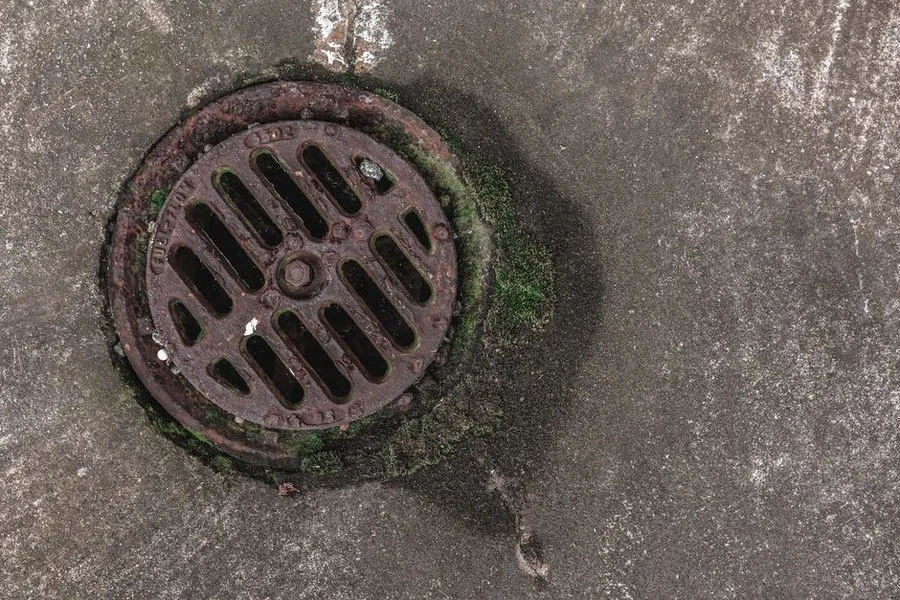
Everything the roof collects funnels through a hole the size of a mug. The covering is dressed into it, which makes it the most complicated detail on the roof, and it sits at the lowest point, which means it is permanently wet and permanently in the path of every leaf, moss fragment and roofing granule the surface sheds.
Outlets fail in three ordinary ways. They block, and the roof becomes a paddling pool. The dressing round the rim degrades and lets water into the deck at the exact spot the roof is least able to cope. Or the leaf guard goes missing - blown off, lifted for a clean and never replaced - and the pipe below silts up somewhere you cannot see. Requirements for rainwater drainage are set out in Approved Document H of the Building Regulations, and larger roofs are expected to have an overflow so that a blockage announces itself with an obvious dribble down a wall rather than by silently loading the structure.
Two minutes with a gloved hand from a ladder at the edge, twice a year, prevents more flat roof damage than any product sold in a tin. It is also the one thing worth checking yourself before you ring anyone when water starts coming through a ceiling.
Gulls, and everything else that lands on a Weston roof
Every town gives its roofs a slightly different diet of debris. Weston’s is distinctive.
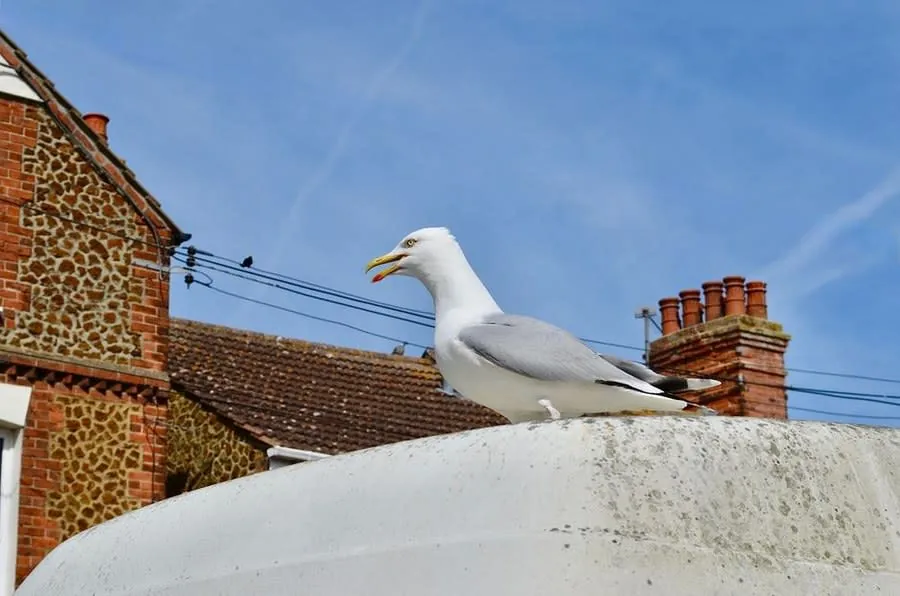
Herring gulls nest on flat roofs here in real numbers, and a nest is not a tidy thing. It is a heap of twigs, seaweed, grass and litter assembled a couple of metres from your outlet, and it sheds into that outlet all season. Gulls are also territorial about the roof they have chosen, which makes clearing it in June both unpleasant and, in the case of an active nest, illegal without a licence - herring gulls are a red-listed species and their nests are protected while in use. Do the clearing in autumn and make the roof less appealing before the birds come back.
Then there is the wind. Weston sits open to the Bristol Channel with very little in the way between it and a south-westerly, so roofs across Uphill, Kewstoke and the seafront collect whatever the wind has picked up on its way in. Inland it changes character completely: the roofs around Banwell, Yatton and Wick St Lawrence get leaves and seeds instead, which rot down into a fine silt that packs an outlet far more effectively than a handful of twigs ever will.
What standing water actually costs you
Ponding gets treated as cosmetic. The physics say otherwise.

Start with weight. Water runs to a tonne per cubic metre, so 25mm of standing water across a modest ten square metre garage roof is 250 litres sitting up there - a quarter of a tonne of dead load on timbers that were never sized for it. The deck sags a fraction more under the weight, which deepens the puddle, which adds more weight. It is a slow feedback loop and it only runs one way.
Then chemistry and biology. A permanently wet area of covering weathers faster than the dry surface around it, particularly on older felts. Moss and algae establish in the wet zone and hold moisture against the material even during dry spells. Silt builds up, ponding water freezes in January and expands into any small crack it has found, and the mineral surfacing gradually washes off into the outlet. And in winter, standing water on the cold outer face changes how the whole build-up behaves thermally, which is often the real story behind a roof that gets blamed for condensation problems it did not cause.
Where it goes once it leaves the roof
The roof is only the first half of the trip. The second half fails just as often and gets diagnosed as a roofing fault, which is expensive for the homeowner and mildly embarrassing for whoever quoted for a new covering without walking round the outside of the house first.

Water leaving a flat roof arrives somewhere - a gutter, a hopper, a downpipe, a gully. If any of those cannot take what is arriving, the water backs up onto the roof and you have a drainage problem that no amount of work on the roof itself will solve. The standard design assumption in this country is rain falling at around 75mm an hour, which is far more than a normal wet Tuesday and roughly what a summer thunderstorm delivers for ten violent minutes.
Common culprits, in the order we find them. A downpipe discharging onto a lower flat roof rather than into a drain, which concentrates the whole upper roof onto one spot of membrane. A gutter that has dropped at the wrong end and now runs uphill. A gully at ground level buried under gravel or a decade of leaf mould. Half of what gets reported to us as a leaking flat roof turns out to be a rainwater goods problem, which is why our work on fascias, soffits and guttering is rarely a separate job from the roofing.
Fixing a roof that cannot drain
Here is the cheerful part. Drainage is one of the few roofing faults with a genuinely permanent answer, rather than a repair that buys time.
If the covering is due for replacement anyway, the fall gets rebuilt as part of the job rather than as an extra. The usual method now is tapered insulation - boards cut to a factory-set gradient, laid to a scheme drawn for your particular roof, which builds the slope and the thermal performance in one layer. Because most flat roof replacements are already going to warm-deck construction to satisfy current insulation standards, the fall arrives more or less for free. Our page on warm roof upgrades covers how that build-up goes together.
Where the covering still has years in it, the options narrow but do not disappear. Re-cutting timber firrings means stripping back to the joists, which is only sensible if you were nearly there anyway. Adding a second outlet at the low point does not fix the shape of the roof but does give the water somewhere to go, and on a roof with a genuine dish in it that can be the difference between a puddle that clears by teatime and one that never leaves. Building up a local low spot in a compatible material is a repair rather than a cure, but an honest one when the roof has five years left and you are not spending on it before then.
What is not worth doing is applying a coating to a roof that ponds. It seals in the problem, adds a layer that has to come off later, and does nothing whatever about the fact that the water still has nowhere to go.
If you have a puddle on a roof in Weston-super-Mare that is still there two days after the rain, that is worth a look before the winter rather than after it. Ask us to take a look at your flat roof and we will tell you which of these it is.
Frequently Asked Questions
How much fall should a flat roof have?
British practice is to end up with at least 1 in 80 across the finished surface, and to design in 1 in 40 so that construction tolerances and a bit of timber deflection do not eat the whole thing. In plain numbers, 1 in 80 over a three metre roof is a drop of roughly 37mm from one end to the other. It is a slope you would struggle to see and would certainly feel if you rolled a marble across it.
Why does water sit on my flat roof after it rains?
Either the fall was never built in, or it has been flattened by the deck sagging over the years, or the water is reaching the outlet and the outlet is blocked. The third one is the cheapest by a distance and worth ruling out first. If the water is nowhere near the outlet and has not moved in two days, the problem is the shape of the roof rather than the drainage fitting.
Can I stop gulls nesting on my flat roof in Weston-super-Mare?
You can make the roof unattractive before the season starts - clearing debris, keeping the outlet guarded and, on larger roofs, fitting wires or spikes. What you cannot do is disturb an active nest with eggs or chicks in it, because herring gulls and their nests are protected by law and removal needs a licence. The practical answer is to deal with it in autumn and winter, not in May.
Does a flat roof need a gutter?
It needs somewhere for the water to go, which is not quite the same thing. Small domestic roofs usually drain over one edge into a conventional gutter. Bigger and enclosed roofs use outlets set into the surface, piped through the building or down an external stack. What matters is that the discharge point can take the volume arriving at it - the standard design assumption in this country is rain falling at about 75mm an hour, which is a lot more than a typical Weston shower.
Free Flat Roof Survey
Somebody comes out, walks the roof and tells you what is wrong before mentioning a price. Anywhere across Weston-super-Mare and North Somerset.